
Multnomah County Detention Center Overview
Multnomah County Detention Center, often shortened to MCDC, is operated by the Multnomah County Sheriff's Office Corrections Division under Sheriff Nicole Morrisey O'Donnell. It is a county jail, not a state prison, and it sits inside the Justice Center in downtown Portland. County and MCSO materials describe MCDC as the initial booking and release point for county arrestees, which means most adults arrested in Multnomah County pass through this building before they are released, assigned housing, transferred to Inverness Jail, or moved through court.
The facility is the maximum-security portion of the Multnomah County jail system. County background material and the MCDC program offer list 448 maximum-security detention beds at MCDC. Those beds support pretrial adults in custody, sentenced local jail terms, high-risk housing, single-cell housing, special medical needs, administrative segregation, mental-health services, disciplinary beds, and court-movement populations. Public roster profiles can identify the assigned facility as MCDC, but the public profile does not provide a housing pod or cell location.
The MCSO jail locations page lists the county jail facilities and links users toward bail, mail, and custody information. The screenshot below shows the official county jail locations page, which is the best starting point when a reader needs to distinguish the downtown Detention Center from Inverness Jail.
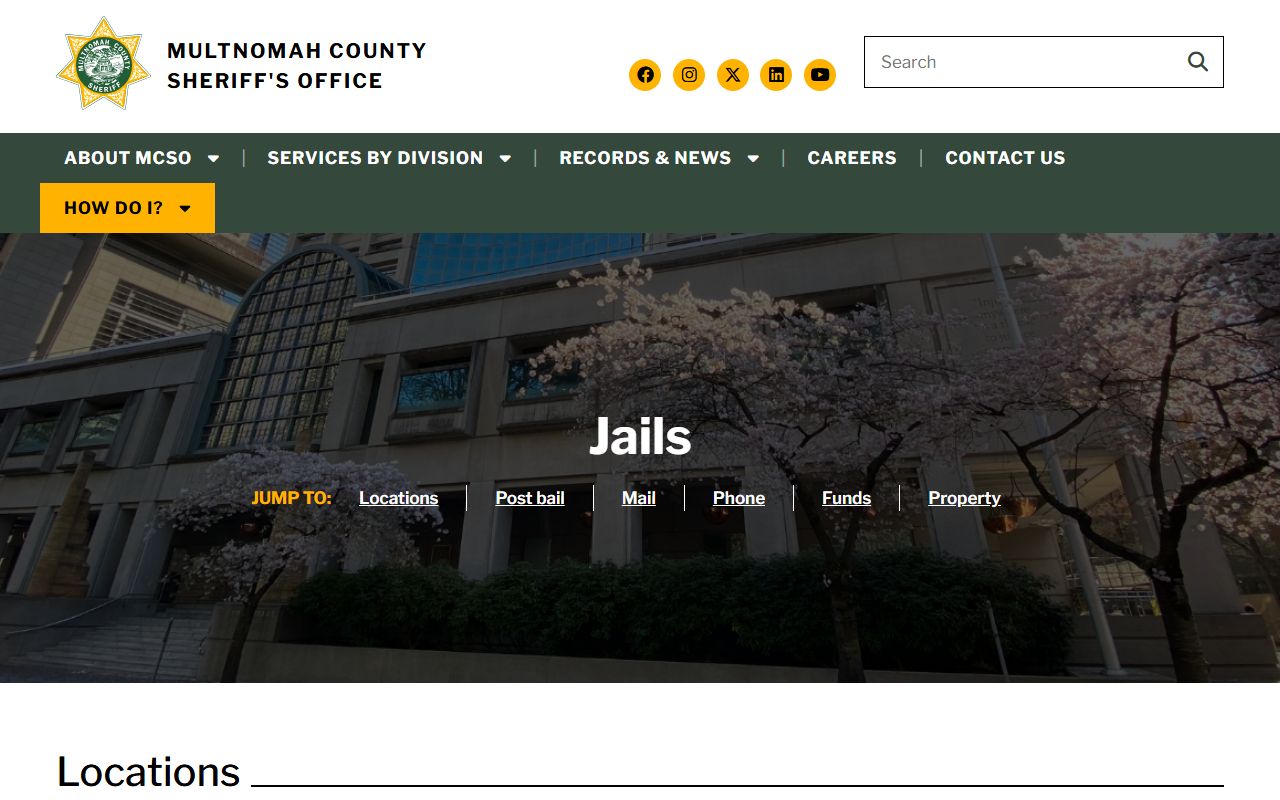
That distinction matters because MCDC handles booking and release, while Inverness serves as the larger lower- and medium-security jail site and the mailing hub for all adults in custody.
Multnomah County Detention Center Capacity and Population
MCDC has a sourced physical capacity of 448 maximum-security detention beds. Multnomah County's combined physical jail capacity is 1,485 beds across MCDC and Inverness Jail, while MCSO monthly reporting uses a countywide funded jail capacity of 1,130 beds. The May 2026 MCSO Monthly Jail Report listed a countywide average daily population of 972, equal to 86 percent of that funded capacity. The report does not break that May 2026 average daily population into a separate MCDC-only count, so the population figure below is the countywide ADP rather than a downtown-only headcount.
The same May 2026 report listed 1,642 standard bookings, 52 average bookings per day, an average length of stay of 18.81 days, and zero forced releases. The emergency population-release threshold is 95 percent of the funded capacity, which MCSO reports as 1,074 people when funded capacity is 1,130 beds.
How to Look Up an Inmate at Multnomah County Detention Center
Use MCSO Public Access Inmate Data, usually called PAID, for current and recent Multnomah County jail custody. PAID covers the county jail population, recent releases, emergency releases, and recent bookings. It is the correct online channel for MCDC because MCDC is part of the county jail system. If the person has been sentenced to Oregon state prison, use Oregon Offender Search or VISOR instead of PAID.
- Open MCSO PAID.
- Enter first name, last name, or both, then choose a search type such as Now In Custody, Released Last 7 Days, Booked Last 7 Days, Booked Today, or Booked Yesterday.
- Review the result table and open the person's linked booking profile.
- Confirm the assigned facility, booking date, SWIS ID, charges, bail fields, court case number, DA case number, and charge status.
The PAID FAQ says the jail information line, (503) 988-3689, is answered 24 hours a day, every day. Use that phone line when the roster is unclear, a person was just arrested, or release timing matters. PAID profiles do not show mugshots because MCSO states it stopped posting booking photos online under Oregon House Bill 3273.
Multnomah County Detention Center Address and Contact
Call the jail information line before traveling for a social visit, bail question, release question, or custody-status confirmation. MCDC is downtown near the Multnomah County Central Courthouse and the Justice Center block, so court movement and jail release processing often intersect at this location.
Multnomah County Detention Center
1120 SW Third Avenue
Portland, OR 97204
(503) 988-3689
Jail information line answered 24 hours a day, every day
MCSO Public Records
501 SE Hawthorne Blvd., Suite 350
Portland, OR 97214
(503) 988-4300
Email: prr@mcso.us
Visiting Someone at Multnomah County Detention Center
MCSO social visits require the visitor to be on the adult in custody's visitor list, including minors. Adult visitors need current valid government photo ID such as a state driver's license, state ID card, military ID card, or passport. MCSO advises visitors to arrive 30 to 60 minutes before the desired session and to sign up at least 30 minutes before the requested visit. Weekend social visiting can be affected by staffing, so call (503) 988-3689 before leaving for the Justice Center. Video visits use Securus Video Visiting and must be scheduled at least 24 hours in advance.
| Visit Channel | Hours / Timing | Type |
|---|---|---|
| Social visit | Arrive 30-60 minutes early; sign up at least 30 minutes before the session | In-person lobby visit under MCSO rules |
| Weekend social visit | Call (503) 988-3689 before traveling because staffing may affect availability | In-person |
| Remote video visit | Schedule at least 24 hours in advance | Securus Video Visiting |
| Lobby video kiosk | Arrive at least 15 minutes early, check in, and show government photo ID | Securus kiosk visit |
| Professional visit | Follow professional-visit rules; not covered by the weekend social-visit staffing notice | Attorney or approved professional |
The MCSO visitation page explains social and video visitation, visitor ID rules, minor visitor requirements, and the weekend call-ahead warning.
Mail, Phone, and Money at Multnomah County Detention Center
Personal mail for a person housed at MCDC does not go to the downtown building. MCSO instructs senders to address all adult-in-custody mail to Inverness Jail, even when the person is assigned to MCDC. The envelope must include Inmate Mail, the booked first and last name, the SWIS ID from PAID, the Inverness Jail address, and a return address. Money deposits use TouchPay with MCSO Facility or pay location code 297204 and the SWIS ID. Phone service and video communications use Securus, and the public cannot call into the jail to speak directly with an adult in custody.
| Service | Provider / Detail |
|---|---|
| Mail Address | Inmate Mail; booked first and last name; SWIS ID; 11540 NE Inverness Drive, Portland, OR 97220 |
| Phone / Video | Securus Technologies for phone accounts and Securus Video Visiting for remote or kiosk video visits |
| Money Deposit | TouchPay online, phone at 1-866-232-1899, or kiosk; use MCSO Facility code 297204 and SWIS ID |
| Legal Mail | Must be clearly marked LEGAL MAIL and is searched for contraband in the recipient's presence |
Booking and Intake at Multnomah County Detention Center
Multnomah County's booking pathway starts at MCDC. Law enforcement brings arrested people to the detention center for intake, booking, holding, and processing. The 2025 correctional-facilities inspection report describes an intake path that includes a body scanner for contraband detection and issuance of facility clothing. MCSO records identity information, fingerprints the person, checks warrants, and begins the custody record that later appears in PAID. Corrections Health screens the person for physical and mental-health needs, and classification staff review risk, prior custody history, current charges, violence or discipline history, behavior alerts, health needs, protection needs, and PREA-related information.
Housing decisions follow that review. County classification material associates high-risk adults, high-risk adults with mental-health conditions, discipline housing, and single-cell placement with MCDC. Lower- and medium-risk adults may be moved to Inverness Jail after initial booking. The county auditor background page reported a median booking time of 4.5 hours for the July 2018 through June 2021 review period, while the PAID FAQ says release after approval can take 4 or 5 hours and that release times are not provided to the public.
Records and Public Access for MCDC Custody
If PAID does not answer the question, use the MCSO public records request process or the Multnomah County Public Records Center. MCSO lists requestable corrections records including custody status, lists of charges, booking photos subject to Oregon law, intake forms, adult-in-custody property, classification information, jail phone calls, jail video calls, and certain jail or building video. MCSO does not provide Multnomah Circuit Court records, 911 audio, police reports from other agencies, or jail medical and mental-health records through that same channel.
Oregon Public Records Law provides the baseline right to inspect non-exempt public records, but exemptions and redactions can apply to criminal investigations, privacy, medical information, and other protected material. For charges filed after arrest, use Oregon Judicial Department records or Multnomah Circuit Court rather than the jail roster. For sentenced state prison custody, use Oregon Offender Search or VISOR.
About Multnomah County Detention Center
MCDC was built in 1983 and remains the county's central intake, release, high-security, and court-movement jail facility. County materials describe cells with a bed, stainless toilet and sink, window, and writing surface, plus units used for high mental-health needs, security threats, and acute observation. The building is transitory for many people because lower-risk adults may move to Inverness after classification, while others remain downtown because of court proximity, security level, medical needs, mental-health needs, discipline, or release processing.
Recent jail conditions reporting has focused on deaths in custody, contraband control, suicide prevention, staffing, inspections, and reforms. MCSO's Corrections Recommendations Project organizes work tied to National Institute of Corrections assessments, Oregon State Police reviews, Oregon Jail Standards inspections, county inspections, grand jury reporting, and prior jail-conditions audits.
Note: Confirm custody, visiting availability, and release questions with MCSO before traveling to the downtown jail.