
Multnomah County Court Records After Arrest
The arrest-to-court path in Multnomah County starts with booking at MCDC, then moves to prosecutor review, arraignment, and Multnomah County Circuit Court records. MCSO PAID may show booking charges first. The District Attorney then reviews the police reports, evidence, and law to decide whether charges should be filed in court. The Multnomah County District Attorney's Office, led by Nathan Vasquez, prosecutes state felony and misdemeanor charges in the county.
Booking charges can differ from court charges. A police arrest charge can be rejected, amended, reduced, replaced by a complaint, filed by information, or presented to a grand jury for indictment. For the custody side of the same event, use Multnomah County jail inmate records. For the booking-photo issue, use Multnomah County jail mugshots, since court records after a jail arrest do not create a public mugshot gallery.
Multnomah Jail Arrest Court Path
Multnomah County materials describe arraignment as usually occurring the next business day after arrest. At arraignment, charges are stated, counsel is addressed, release or security release may be decided for an in-custody defendant, conditions can be set, and the next hearing is scheduled. If the case is a felony and the defendant is in jail, the grand jury usually occurs within five business days after first arraignment, followed by a second arraignment when an indictment is returned.
- The person is arrested and booked by MCSO at the county jail intake point.
- MCSO creates custody data that may appear in PAID, including booking date, charge text, facility assignment, and case identifiers when available.
- The District Attorney receives the case through arrest, citation, or law-enforcement reports and reviews it before the first court date when an arrest has been made.
- Multnomah County Circuit Court records begin once the case is filed and indexed in the Oregon Judicial Department system.
- The case record then tracks filed charges, hearings, release decisions, warrants, disposition, and sentencing.
Multnomah Court Records Search
The main free search path is the Oregon Judicial Department records and calendars portal. It gives basic case information and calendars. It does not provide every document or restricted detail. Full documents may require a copy request from the court or paid access through OJCIN Online, which includes Register of Actions and judgment records for Oregon courts but still notes that the official court record is held by the court.
The OJD records and calendars page is the entry point for many Multnomah County court records after arrest searches.
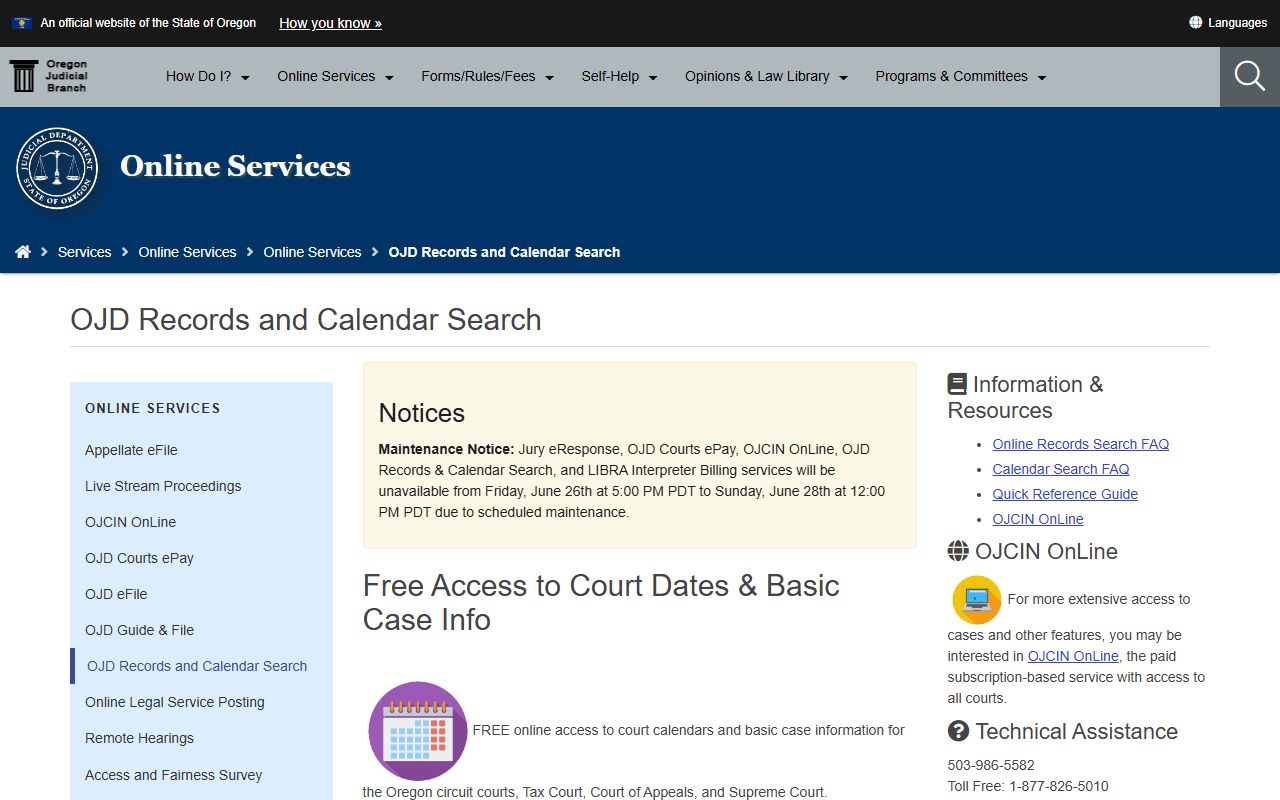
The search works best when a PAID booking profile supplies a court case number, citation number, or exact booked name.
| Field Label | Type | Required | Options / Format Notes |
|---|---|---|---|
| Smart Search | Text | Unspecified | Search by court record number, case number, citation number, or party name. |
| Party name | Text format | Unspecified | Use Last Name, First Name. |
| Court Location | Filter | Optional | Choose Multnomah to narrow local cases. |
| Search Type | Filter | Optional | Attorney, business, case number, citation number, judicial officer, nickname, or party name. |
| Cases and Judgments | Filter | Optional | Narrows by case or judgment category. |
| Filed Date | Date filter | Optional | Use a date range when many similar names appear. |
| Search behavior | Results | n/a | First 200 results only; wildcard * and Sounds Like features are documented. |
Multnomah County Court Copies
The Multnomah County Circuit Court Records Department handles copy requests for local court records. Request channels include an online form, email at MUL.Records@ojd.state.or.us, mailed request form, phone at (971) 274-0570, and walk-in service at the courthouse records counter. Useful facts for a copy request include case number, approximate filing year or date, party names, defendant date of birth for criminal cases, document title, copy type, and delivery method.
Walk-in records service is listed at Multnomah County Courthouse, 1200 SW 1st Ave, Room 3315, Portland, OR 97204, Monday through Friday from 8:00 a.m. to 4:00 p.m. Phone hours found in the research were Monday through Friday, 8:30 to 10:30 a.m. or 1:30 to 4:00 p.m. to speak with records staff.
Multnomah Arrest Charging Documents
A charging document is the formal paper that tells the court what accusation is being made. In Multnomah County, the jail booking may list one set of charge labels while the court record later shows the DA's filed complaint, information, indictment, amended charge, or dismissal. The distinction matters because the court record controls the case path, not the initial booking label.
| Document | Who Uses It | What It Means After Arrest |
|---|---|---|
| Complaint | Prosecutor or authorized charging source | A formal accusation that can start the criminal case and support arraignment. |
| Information | Prosecutor | A prosecutor-filed charging instrument used for charges the DA elects to pursue. |
| Indictment | Grand jury | A grand-jury charging document, often tied to felony cases after presentation. |
Multnomah County Charge Status
Charge status changes as a case moves through court. A pending charge has not been resolved. An amended charge has been changed by prosecutor or court action. A reduced charge is replaced with a lesser charge. A dismissed charge ends without conviction on that charge. An acquittal means not guilty. A conviction means guilt was adjudicated by plea or verdict. Sentenced means punishment or judgment has been entered.
| Status | What It Means | Record Caution |
|---|---|---|
| Pending | The charge remains unresolved. | Do not treat it as a conviction. |
| Amended | The charge text, level, or count changed. | Compare current court record with older booking data. |
| Reduced | A lesser charge replaced a higher or different charge. | Final disposition may differ from initial arrest language. |
| Dismissed | The charge ended without conviction on that charge. | Other counts in the case may still remain. |
| Acquitted | The person was found not guilty. | It is not a conviction. |
| Convicted | Guilt was adjudicated by plea or verdict. | Check sentencing and judgment entries. |
| No complaint or rejected | The DA did not file at that time. | MCDA may reconsider if new evidence arrives. |
Multnomah Court Release Records
Oregon does not use commercial bail bond companies. Multnomah County and Oregon court materials use terms such as recognizance release, conditional release, and security release. At first appearance or arraignment, the judge may set conditions, decide release, or set a security amount. A 10 percent security deposit may be required in some cases, and the court can retain 15 percent of posted security release within the limits described by Oregon law.
Money does not always release a person. A no-bond hold, another-county warrant, probation or parole issue, federal marshal hold, or immigration matter can keep someone in custody after local bail or release conditions are addressed. The court record may show release conditions, warrants, failure-to-appear events, or security judgments, while PAID shows the jail custody side.
Multnomah County Arrest Warrants
No official public active-warrant search table was found for Multnomah County. The researched path is phone and court based. MCSO guidance and the MCDA outstanding-warrants page point warrant questions to Multnomah County Courts at (971) 274-0545. The PAID FAQ also lists Court Information at (503) 988-3235. A warrant arrest can create a new PAID booking after the person is booked, but the warrant itself should be checked with the court or through records channels.
Common warrant terms include arrest warrant, bench warrant, fugitive warrant, and search warrant. A bench warrant usually follows failure to appear or failure to comply with a court order. A search warrant authorizes a search and is not itself a jail lookup. Fugitive or outside-jurisdiction warrants can create holds that affect release.
Multnomah Charges vs Convictions
A charge is an accusation. A conviction is a final legal result based on a plea or verdict. Multnomah County court records after a jail arrest may show charges that are pending, amended, dismissed, or reduced before any final judgment. That is why a case lookup should separate accusation, current status, and final disposition.
| Point | Charge | Conviction |
|---|---|---|
| Stage | Accusation filed in court. | Guilt adjudicated by plea or verdict. |
| Proof | Case proceeds under charging and probable-cause standards. | Criminal guilt requires proof beyond a reasonable doubt or a valid plea. |
| Record meaning | Shows what was alleged or pending. | Shows the final guilty outcome for that count. |
| Search caution | May be dismissed, amended, or reduced. | Check judgment and sentencing terms. |
Multnomah Sealed Court Records
Oregon uses the term "set aside" for qualifying arrest or conviction records under ORS 137.225. The result is often described as sealing because the public record is restricted after the court grants relief. Eligibility depends on the charge, disposition, waiting period, and other statutory conditions. Juvenile, adoption, mental-health, VAWA-protected, medical, and other restricted records can also be excluded from public access under court rules and public-records limits.
| Point | Sealed / Set Aside | Expunged |
|---|---|---|
| Oregon wording | Set aside is the Oregon statutory term for many qualifying arrests or convictions. | Often used casually, but the court process should be checked under Oregon law. |
| Visibility | Public access is restricted after a court order. | The practical goal is removal from public view when law allows. |
| Eligibility | Depends on ORS 137.225 and case facts. | Do not assume every dismissal, arrest, or conviction qualifies. |
| Where to verify | Multnomah Circuit Court records and the case docket. | Court order and official record holder. |
Restricted Multnomah Court Records
OJD says free public access does not include full documents, addresses, Social Security numbers, juvenile and adoption files, mental-health matters, VAWA-protected information, and other restricted categories. Oregon public-records law also allows criminal investigation, privacy, medical, and other protected information to be withheld or redacted. A public court index may confirm that a case exists while still limiting document access.
Important: Court, jail, and charge records are not consumer reports and should not be used for FCRA-covered decisions.